
Living in a compact apartment or a cozy home has its charms, but there’s no denying the frustration of a room that feels like it’s closing in on you. Whether it’s a bedroom barely big enough for a queen bed, a living room where the sofa dominates everything, or a home office where you’re practically sitting in a closet, limited square footage is one of the most common challenges homeowners and renters face worldwide.
Here’s the good news: knowing how to make a small room look bigger has nothing to do with knocking down walls or hiring an expensive interior designer. Visual design psychology is remarkably powerful. With the right colors, furniture choices, lighting, and a few clever DIY upgrades, you can completely transform how a room feels — often spending less than $100 total.
This guide covers 15 practical, budget-friendly tricks that genuinely work. You won’t find vague advice here. Every tip comes with the reasoning behind it, clear implementation steps, and realistic cost estimates.
Why Small Rooms Often Feel Smaller Than They Actually Are
Before diving into solutions, it helps to understand why small rooms feel cramped in the first place. The answer lies in how the human brain perceives space.
Our eyes naturally track contrast, clutter, and visual “stops” — anything that interrupts a sightline and signals a boundary. When a room has too many competing colors, bulky furniture pushed against every wall, and poor lighting that creates shadows in corners, the brain registers all of those stops as walls closing in.
The most common design mistakes that shrink a room visually include placing oversized furniture in tight spaces, using multiple dark or mismatched paint colors, blocking natural light with heavy curtains, and filling every shelf, surface, and corner with objects. Each of these mistakes adds visual noise that signals confinement.
On the flip side, rooms feel larger when the eye can travel freely. Continuous colors, open floor space, good light, and clean lines all signal openness — even if the actual square footage hasn’t changed by a single inch.
Understanding this principle is the foundation for every trick in this article. You’re not changing the room; you’re changing what the brain reads when it scans the room.
15 Smart DIY Tricks to Make a Small Room Look Bigger on a Budget
1. Use Light Paint Colors
Paint is the single highest-impact, lowest-cost change you can make to any room. Light colors reflect more light, which makes walls feel further away and ceilings feel higher. Soft whites, warm creams, pale grays, and light sage greens are consistently effective choices.
The science behind this is simple: light-toned walls bounce natural and artificial light around the room rather than absorbing it. Dark walls absorb light, pull the room inward, and make the space feel intimate — sometimes cozy, but often claustrophobic in an already small room.
For a DIY approach, prep your walls properly by cleaning them and filling any holes with spackle. Use a quality primer before applying your light paint, especially if you’re covering a darker color. One coat of primer and two coats of paint typically cost $40–$70 for a standard bedroom, including brushes and rollers.
One underused expert trick: paint your ceiling the same color as your walls, or even a shade lighter. This removes the visual boundary between the wall and ceiling, making the room feel taller and more open.
2. Add Mirrors Strategically
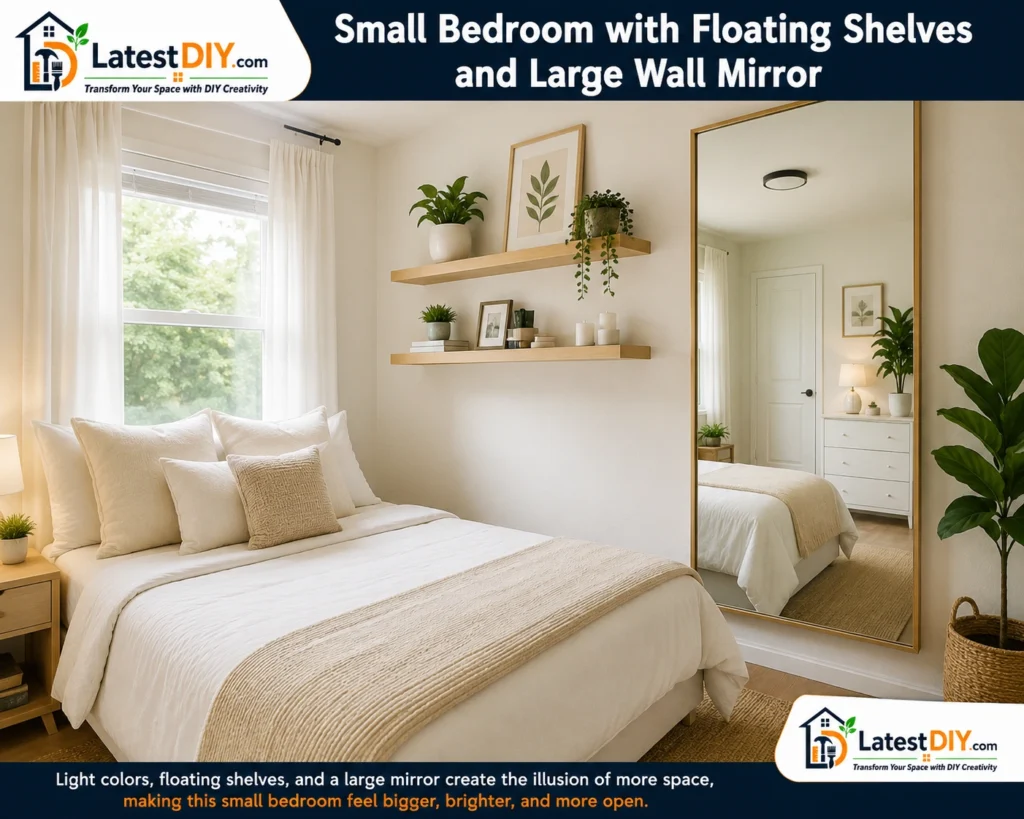
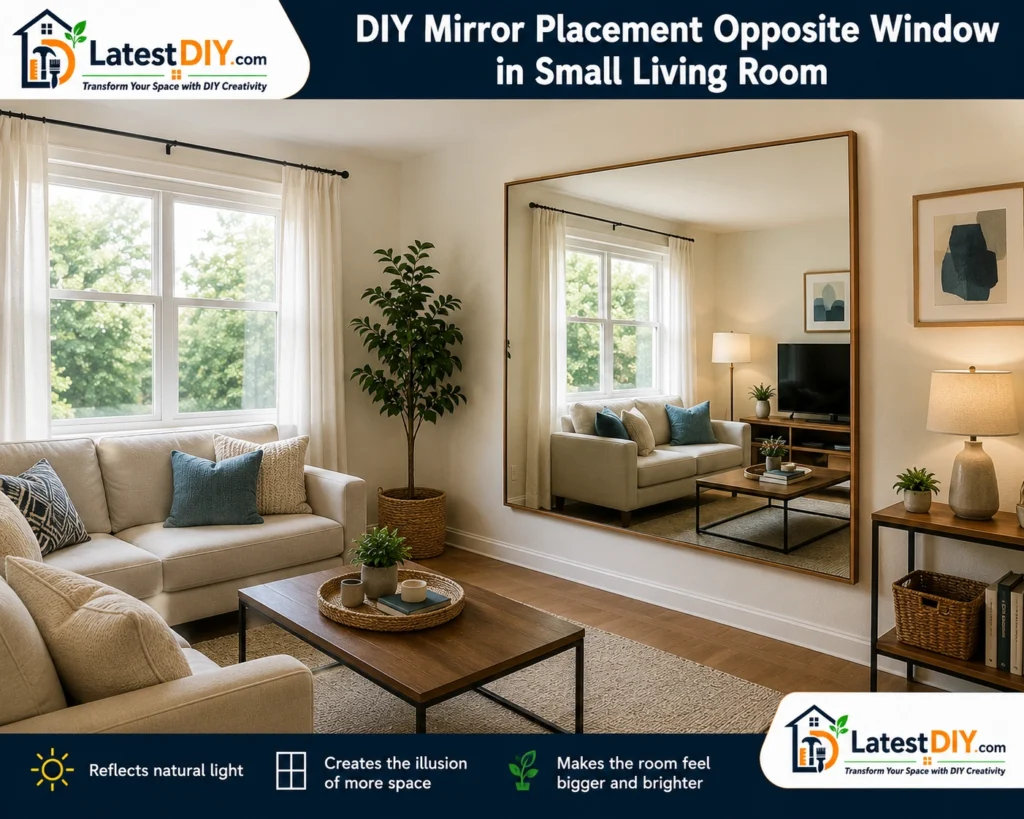
Mirrors are a designer’s secret weapon for small spaces, and for good reason — they literally double the visual depth of a room. When placed thoughtfully, a mirror creates the illusion of another room or a window opening onto more space.
The key word here is “strategically.” A mirror placed on a wall directly opposite a window will reflect natural light back into the room, instantly brightening the space and making it feel larger. A large floor mirror leaned casually against a wall (rather than hung) also adds height and an airy, modern feel without requiring any hardware.
For a budget DIY option, check thrift stores for large frames, spray paint them in a metallic or neutral tone, and either use mirror adhesive film (available for around $15–$25 on Amazon) or swap in a new mirror from a home improvement store. Full-length mirrors from discount retailers often cost $30–$60 and can be incredibly effective when positioned near a light source.
Avoid placing mirrors facing each other — this creates a funhouse infinity effect rather than an illusion of depth.
3. Maximize Natural Light
No amount of artificial lighting can replicate what natural light does for a room. Daylight is dynamic, it changes throughout the day, and it has a quality that makes spaces feel alive and open in a way that bulbs simply can’t match.
Most people block significant amounts of natural light without realizing it. Heavy curtains that hang just inside the window frame, furniture positioned too close to windows, and dark blinds all cut off the room’s primary source of visual expansion.
The DIY fix is inexpensive and often costs nothing. Move furniture away from windows. Replace heavy drapes with sheer curtain panels ($10–$25 per panel at most home goods stores). If you need privacy but still want light, frosted window film is an excellent solution at around $15–$30 per roll and takes about 20 minutes to apply.
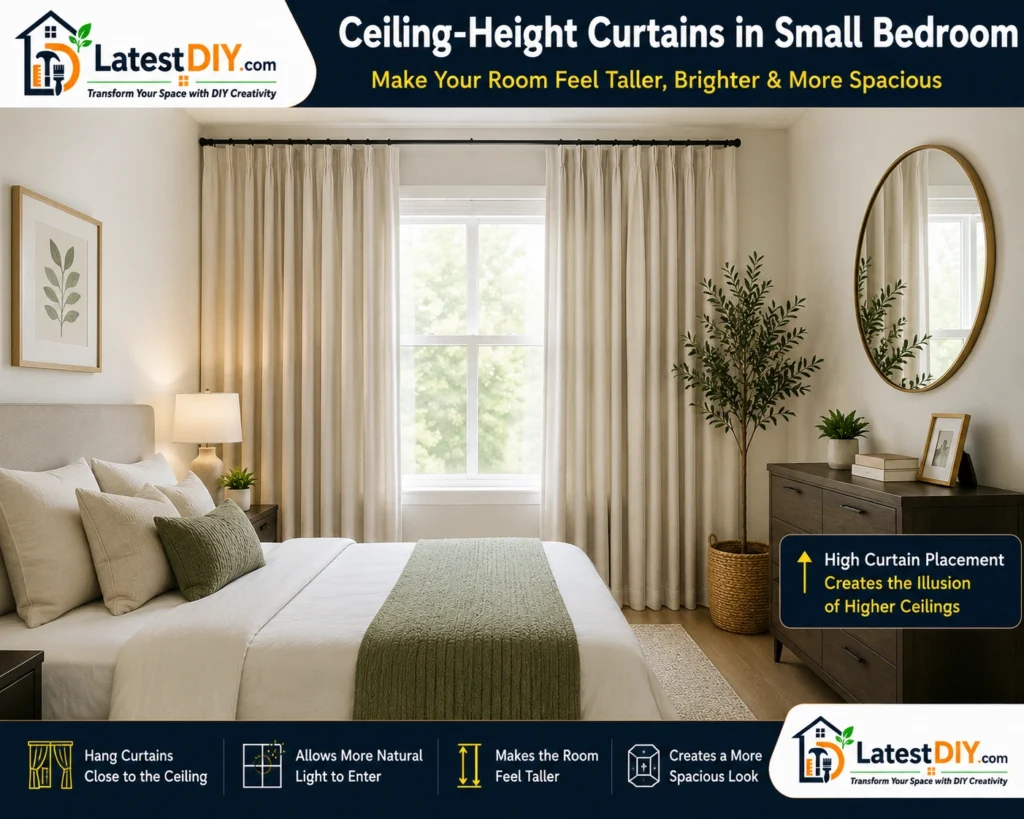
Hanging curtain rods as close to the ceiling as possible — and extending the rod at least 6 inches beyond each side of the window frame — makes windows appear dramatically larger and floods the room with more light.
4. Choose Multi-Functional Furniture
In a small room, every piece of furniture needs to earn its place. Multi-functional furniture eliminates the need for multiple pieces, which directly reduces visual clutter and frees up floor space.
An ottoman with hidden storage replaces both a coffee table and a storage bin. A bed frame with built-in drawers eliminates the need for a bulky dresser. A wall-mounted fold-down desk can serve as a workspace by day and fold flat against the wall at night, leaving the floor completely clear.
The DIY angle here involves either purchasing smart pieces affordably (check IKEA, Facebook Marketplace, or thrift stores) or modifying existing furniture. Adding caster wheels to a storage trunk, for instance, turns it into a rolling coffee table. Building a simple wooden box platform for a mattress with plywood sides and a hinged lid creates storage underneath without buying an expensive bed frame.
Budget tip: IKEA’s KALLAX shelving unit doubles as both storage and a room divider, and can be found second-hand for as little as $20–$40.
5. Declutter and Organize
This one costs nothing except time, yet it may be the most powerful trick on this entire list. Visual clutter is the number one reason small rooms feel suffocating. Every unnecessary object on a surface, floor, or shelf adds a visual stop that interrupts the eye’s flow across the room.
Decluttering isn’t just about throwing things away. It’s about deciding what truly needs to be visible and what can be stored out of sight. A general rule that works well: if you haven’t touched it in three months, it either needs a proper home out of sight or it needs to leave the room entirely.
Once items are removed, focus on organizing what remains. Use lidded boxes and baskets to contain small items on shelves. Cable management behind desks and entertainment units makes a surprising difference. Even neatly arranging books by color or size on a shelf creates a calmer, more ordered look that reads as more spacious.
The result of a good declutter session is immediate and dramatic — without spending a single dollar.
6. Install Floating Shelves
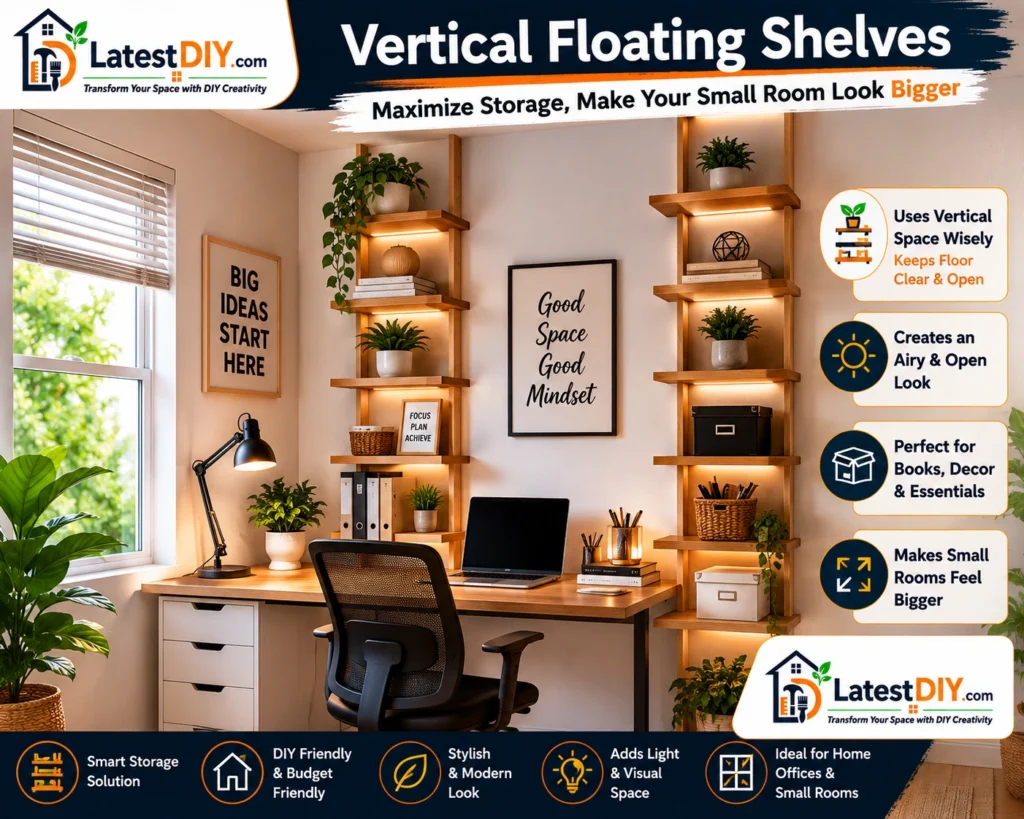
Standard bookshelves and storage units sit on the floor and occupy precious square footage. Floating shelves, mounted directly to the wall, provide the same storage capacity while keeping the floor completely clear — which is one of the most effective ways to make a room feel larger.
The perception here is straightforward: visible floor space signals openness. When you can see more of the floor, the room reads as bigger.
Installing floating shelves is a beginner-level DIY project. You’ll need a stud finder ($15–$20), a level, screws, wall anchors for spaces between studs, and the shelf brackets and boards themselves. Pre-built floating shelves at home improvement stores run $15–$40 each, or you can build them from 1×10 pine boards for around $8–$15 per shelf.
Mount shelves higher on the wall — ideally above eye level — to draw the eye upward and make ceilings feel higher. Keep what you display on them minimal and curated: a few books, one or two small plants, a candle or two. Overstuffed floating shelves defeat the purpose.
7. Use Vertical Storage Solutions
When floor space is scarce, the solution is simple: go vertical. Most rooms have between 8 and 10 feet of wall height, yet the majority of storage solutions stop at about 5 or 6 feet, wasting the upper third of every wall entirely.
Tall, vertical storage draws the eye upward and makes ceilings feel higher than they actually are. A floor-to-ceiling bookshelf, stacked cube organizers reaching toward the top of the wall, or a pegboard system (incredibly popular in small home offices and kitchens) all use vertical space efficiently while making the room feel more proportionate.
For a budget DIY approach, stacked cube shelving systems like IKEA’s KALLAX can be configured vertically for around $60–$100 for a tall unit. Pegboards are an even cheaper option — a 4×4 foot pegboard sheet costs about $15 at hardware stores, and hooks and accessories add another $10–$20.
The key is consistency: keep vertical storage organized and avoid making it look chaotic. A well-organized tall shelf looks architectural; a cluttered one looks overwhelming.
8. Hang Curtains Higher

This is one of the simplest and most cost-effective tricks in this entire guide, and the transformation is often shocking for how little it costs.
Standard curtain placement hangs rods just a few inches above the window frame. This frames the window accurately but does nothing to make the room feel taller or larger. When you raise the curtain rod to just below the ceiling — or even ceiling height — and let the curtains fall all the way to the floor, the eye follows the vertical line from ceiling to floor. This makes both the window and the ceiling appear dramatically higher.
New curtain rods cost $10–$25 at most discount home stores. If you’re reusing your existing curtains and they’re now too short, hang them anyway — curtains that hang just above the floor without puddling actually look very intentional and modern. The vertical line is what matters, not whether the curtain fills the full length.
Stick to light, solid colors or subtle patterns. Heavy patterns and dark colors on curtains visually shrink the wall they’re on.
9. Choose Furniture with Visible Legs
Low-profile sofas, bed frames, and chairs that sit directly on the floor create a solid mass that the eye reads as blocking space. Furniture raised on visible legs, even a few inches off the floor, allows light to pass underneath and lets the eye continue across the floor rather than stopping at a solid barrier.
This principle works because the brain reads that sliver of visible floor under a sofa or chair as continuous floor space. The room appears to have more floor area than it actually does.
When shopping for furniture on a budget, look specifically for pieces with tapered wooden or metal legs. Mid-century modern style furniture, which is widely available at thrift stores and on Facebook Marketplace for very reasonable prices, almost always features this leg design. If you already own furniture with a solid base, consider whether adding furniture legs is feasible — many platforms and frames can be retrofitted with screw-in legs from hardware stores for $15–$30 total.
10. Create a Consistent Color Scheme
Color variety is visually stimulating, but in a small room, too much variety creates the same effect as clutter. Every time the eye transitions between different colors on walls, furniture, rugs, and accessories, it registers a visual boundary — and more boundaries mean a smaller-feeling space.
A cohesive, limited color palette with two or three complementary colors makes a room feel calm and continuous. Rather than a bright blue sofa, orange throw pillows, green curtains, and a red rug, consider choosing one anchor color and building around it with neutrals and one or two accent tones.
This doesn’t require buying new furniture. Often it just means swapping out accessories: new throw pillows, a different rug, or changing the color of a lamp shade. These changes can cost as little as $20–$50 total from discount stores or thrift shops.
A monochromatic scheme — different shades of the same color — is particularly effective in small rooms because it almost completely eliminates visual stops.
11. Use Large-Scale Wall Art
This is counterintuitive for many people, but using one large piece of wall art creates a far more spacious feeling than filling the same wall with many smaller pieces. A gallery wall of 10 small frames creates 10 separate focal points, each registering as a visual stop. One oversized art print creates a single statement that draws the eye to a specific point and then lets it rest.
Large art also fills wall space confidently, which paradoxically makes the room feel less cluttered and more curated.
For a budget approach, poster-sized prints from Etsy or Society6 can be found for $15–$30, and large frames from thrift stores or IKEA typically run $10–$25. DIY canvas art using stretched canvas from a craft store (about $15–$30 for a 24×36 inch canvas) painted in abstract shapes with acrylic paint creates a striking, custom piece for under $40.
Keep the subject matter light — landscapes, abstract shapes, or botanicals all work well. Busy, dark, or intensely complex artwork makes a small wall feel crowded.
12. Add Smart Lighting Layers
Overhead lighting is convenient but deeply unflattering in small spaces. A single overhead light source casts flat, even illumination that flattens the room and makes it look like a box. Layered lighting, by contrast, creates depth and warmth that tricks the eye into perceiving more dimension.
The three layers to work with are: ambient (general overhead or ceiling lighting), task (lamps for specific activities), and accent (directional lighting to highlight walls, corners, or art). Using all three in combination creates visual depth that makes a room feel larger.
For a DIY budget approach, floor lamps with uplighting cast light toward the ceiling, which makes ceilings appear higher. Wall sconces (which require minimal wiring if you choose plug-in versions at $20–$50 each) add light at a mid-wall level. LED strip lights behind furniture or along the top of shelving units create a glow that separates walls visually and adds the impression of depth.
Smart bulbs with adjustable color temperature let you shift from cool daylight tones (energizing, great for making a room feel airy) to warm tones (cozy, ideal for evenings) without replacing fixtures.
13. Keep Floors Visible
The amount of visible floor space in a room is one of the most powerful determinants of how open it feels. When floors are covered by furniture legs, rugs that are too large, scattered items, or boxes and bags shoved in corners, the brain registers a crowded, cramped space.
The goal is to maximize the amount of floor you can actually see. Pull furniture slightly away from walls — counterintuitively, this creates more visible space, not less. Choose area rugs that are appropriately sized: in a small living room, a rug that only fits under the front legs of the sofa rather than covering the entire seating area actually makes the room look smaller. Use a rug that either fills most of the space or is small enough to define just a single zone clearly.
For flooring choices, light-colored floors reflect more light and read as more expansive. If you have dark floors and can’t replace them, a light-colored area rug in the center of the room achieves a similar effect. Rugs with a simple pattern or solid color in a neutral tone are best — complex patterns fragment the floor visually.
14. Use Foldable or Stackable Furniture
One of the most practical small-space solutions is furniture that disappears when you don’t need it. A folding dining table mounted to the wall takes up zero floor space until mealtimes. Stackable chairs can be stored in a closet and brought out only when guests arrive. A folding desk stows flat against the wall when the workday ends.
This approach is particularly valuable in studio apartments and multi-purpose rooms where a single space needs to serve several functions throughout the day.
Many budget-friendly folding furniture options are available at IKEA, Target, and Amazon for $30–$100. The IKEA NORBERG wall-mounted drop-leaf table, for example, folds completely flat and costs around $40. DIY wall-mounted folding desks can be built with a single piece of plywood, two piano hinges, and a wall bracket for under $50 in materials.
The only caution: avoid the temptation to fill the space created when items are folded away. The open floor space itself is the benefit.
15. Create a Strong Focal Point
Every well-designed room has one element that the eye is drawn to first. In a small room, having a clear focal point actually creates a sense of order and spaciousness — the eye knows exactly where to go, rather than darting around looking for something to land on.
A focal point can be a feature wall in a slightly bolder color or with an interesting texture (a DIY shiplap accent wall using thin plywood planks costs $40–$80 in materials), a large piece of art as discussed earlier, a statement headboard in a bedroom, or an eye-catching piece of furniture.
The trick is that a focal point needs to be just one element. If you create three or four statement areas in a small room, the effect is chaos rather than focus. Pick one wall or one piece, give it intentional attention, and let the rest of the room play a supporting role with simpler, quieter choices.
Budget-Friendly DIY Upgrades That Instantly Improve Room Size Perception
Beyond the 15 main tricks, a few quick upgrades can make an immediate difference without much effort or cost.
Adding a strip of crown molding or a thin ledge shelf at ceiling height draws the eye upward and makes walls feel taller. Metallic or glossy paint on a single accent wall reflects light similarly to a mirror and adds depth. Replacing standard door hardware with longer, more prominent handles makes doors look more architectural and intentional rather than just functional. Using the same flooring or rug color in adjacent rooms (visible through doorways) creates a sense of flow that makes both spaces feel larger.
Removing interior doors entirely and replacing them with curtains can open up a small room significantly, especially for closets and pantries.
Common Small Room Decorating Mistakes to Avoid
Even well-intentioned decorating choices can make a small room feel smaller if you fall into these traps.
Overcrowding with furniture is the most common mistake. Many people try to fit every piece they own into a room and end up with a floor plan where you’re constantly navigating around furniture. A room with fewer, well-chosen pieces almost always feels larger than one stuffed to capacity.
Using multiple dark colors throughout the space — dark walls, dark floors, dark furniture, and dark curtains — absorbs light from every angle and creates an enclosed, heavy atmosphere. One dark element can be striking; an entirely dark room feels oppressive in a small space.
Poor lighting, especially relying solely on a single overhead fixture, flattens the room and highlights its size limits. Similarly, ignoring vertical space by keeping everything at eye level or below wastes the visual height of the room.
Excessive decorations and trinkets on every surface create visual noise. Even if each individual item is beautiful, too many objects compete for attention and make the brain work harder to process the space — which reads as cramped.
Finally, blocking windows with furniture or heavy treatments cuts off the room’s primary source of both light and the visual connection to outdoor space — one of the most effective natural space expanders available.
Realistic Budget Breakdown for a Small Room Makeover
Here’s a practical cost estimate for a complete small room transformation, assuming you’re starting from scratch with a standard 10×12 bedroom:
- Paint (walls + ceiling): $40–$70 for paint, primer, rollers, and brushes.
- Mirrors: $30–$80 for one large floor or wall mirror from a discount retailer or thrift store.
- Curtains and rods: $30–$60 for sheer panels and an extended curtain rod, hung high.
- Floating shelves (two to three shelves): $30–$80, including brackets and mounting hardware.
- Lighting upgrades (one floor lamp + LED strips): $30–$70.
- Multi-functional storage (IKEA or thrift store find): $20–$80.
- Decluttering supplies (baskets, boxes): $15–$30.
- Wall art (one large print + frame): $20–$50.
- Total estimated range: $215–$520 for a complete room transformation — far less than a renovation, and often achievable for under $300 if you shop secondhand and DIY where possible.
Expert Tips for Maintaining an Open and Spacious Look Long-Term
The effort you put into transforming a small room is wasted if the space gradually fills back up with clutter and chaos. Maintaining an open, spacious look is ultimately about building habits, not just making one-time changes.
Adopt a “one in, one out” rule: whenever something new enters the room, something old must leave. This keeps the overall volume of items stable over time. Dedicate 10 minutes each week to a quick tidy — returning items to their proper storage place before they accumulate into a pile.
Reassess the room seasonally. Swap out seasonal items (heavy blankets, extra lighting, seasonal decor) so the room never becomes permanently overstuffed. Donate or sell anything that hasn’t been used in the previous season.
Keep surfaces clear as a default. Countertops, nightstands, and coffee tables should have only the items that are used daily. Everything else finds a proper home in a drawer, basket, or closet.
Finally, trust the negative space. Empty wall space, clear floor area, and uncluttered surfaces aren’t wasted — they’re what makes the room feel like it can breathe.
Final Advice
Making a small room look bigger doesn’t require a renovation budget, a contractor, or even a free weekend. The most effective changes — lighter paint, strategic mirrors, high curtains, decluttered surfaces, and smart lighting — can be accomplished over a few evenings for well under $300, and some of them cost nothing at all.
The most important takeaway from this guide on how to make a small room look bigger is that perception is everything. You’re not adding square footage; you’re removing the design signals that tell your brain the room is small. Clear the floors, reflect the light, unify the colors, and let the vertical space work in your favor.
Start with one change this week. Repaint a wall, hang a mirror opposite a window, or spend an afternoon decluttering. Each improvement compounds the effect of the ones before it, and within a few weeks you’ll have a room that feels genuinely spacious — regardless of what the measuring tape says.
Frequently Asked Questions (FAQs)
How can I make a small bedroom look bigger without spending any money?
Decluttering, rearranging furniture, and maximizing natural light are the easiest ways to make a small bedroom feel larger without spending money. Keeping surfaces clear and creating open floor space can instantly improve the room’s appearance.
What paint colors make a small room look bigger and brighter?
Light colors such as white, cream, soft gray, and pale beige reflect more light and make walls appear farther apart. These shades help create a brighter and more spacious feeling.
Do mirrors actually make a room look bigger, or is that a myth?
Yes, mirrors create the illusion of extra space by reflecting light and adding visual depth. Placing a large mirror opposite a window can make a room feel noticeably larger and brighter.
How do I maximize storage in a small room without making it feel cluttered?
Use hidden storage solutions such as ottomans, under-bed containers, and furniture with built-in storage. Vertical shelving and wall-mounted organizers also help maximize space while keeping the room tidy.
What type of lighting works best in a small bedroom?
Layered lighting works best in small bedrooms. Combining ceiling lights, bedside lamps, and accent lighting reduces shadows and helps the room feel more open and inviting.
Can furniture placement alone make a small room feel bigger?
Yes, strategic furniture placement can significantly improve the perception of space. Keeping walkways clear and avoiding oversized furniture helps create a more open and comfortable layout.
What is the single biggest decorating mistake in small rooms?
The biggest mistake is overcrowding the room with oversized furniture and excessive décor. Choosing appropriately sized furniture and maintaining a clutter-free space makes a room feel much larger.
