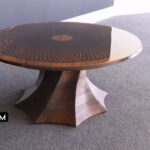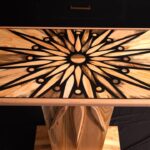
Let me tell you how I managed to get myself into one of my biggest problems. It all started with a client who told me she had been looking at these incredible sofa designs generated by artificial intelligence and asked if I could build something like that for her. At first I said no way, that is impossible. But since I am both stubborn and not exactly the sharpest tool in the shed, I could not get the idea out of my head.
One thing led to another and now here I am with over five hundred kilos of mahogany and a promise to build something that at first seemed absolutely impossible. Let’s check if I really got what I ordered. Wood like this, kiln dried and with barely any cracks or defects, has not been particularly cheap. I got these three beautiful mahogany slabs all from the same tree so the color and the grain will stay consistent.
Each one is almost twelve centimeters thick and I can already tell working with them on my own will not be easy. The result turned out amazing and I could not be happier with it. Instead of wondering whether it would work or not, the focus here is the entire process it took to get there.
This project quickly turned into the most complicated thing I have ever built. The engineering, the planning, the design and the physical work required were far beyond a normal woodworking project. From the moment the mahogany slabs arrived to the final sanding and finishing, every step required patience and careful thinking.
The Massive Mahogany Slabs
The first thing I needed to do was take one of the three slabs to a sawmill and have it cut in half. I needed pieces that were about half as thick as they were originally.
Machines like these have always fascinated me and one of my goals is to have one someday. But that would require money, space and actually learning how to use it properly.
It is incredible how much internal tension a slab like this can hold. As soon as it was cut both pieces immediately warped almost like a spring. Toward the end the machine almost stalled because the sides of the slab pressed against the saw blade like a clamp.
It is one of those things you do not really think about until you actually see it happen. Fresh wood does not have this kind of tension yet, but completely dry wood often does.
Designing the Sofa Before Building
Back in the shop it was finally time to start cutting the wood.
This is without a doubt the project that required the most time designing and planning before even starting. Normally the approach is simple: start building and solve problems as they appear.
But something about this project told me that jumping in blindly would be a bad idea. If I approached it that way there would probably be no way to actually pull it off.
So this time I tried to act like a responsible woodworker.
The idea needed to meet two important conditions:
- It had to match what the client had in mind.
- It had to be something I could realistically build.
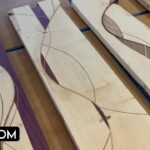
After sketching many ideas and scrapping most of them I finally reached a design that both the client and I liked.
One important condition was that it had to be a chaise lounge. A regular sofa made out of five hundred kilos of solid wood simply would not have been challenging enough.
Cutting and Preparing the Wood
Cutting slabs this thick requires paying attention to how the board is positioned. Almost every board has some bow to it.
Whenever cutting a long wide heavy board along the grain the concave side should face up. If it faces down the cut ends hang in the air and when the two halves drop they clamp the blade and stop the saw from moving forward.
That can cause a dangerous kickback that sends the saw backward.
Deep cuts should also be done in two passes. Otherwise the blade heats up too much and burns the wood.
Some sections were too thick for the track saw so the final part had to be cut by hand. With an old shoulder injury that was not exactly pleasant, but sometimes there is simply no other option.
Why Mahogany Was Chosen
The wood chosen for this project was mahogany, specifically a type called kaya, often known as African mahogany.
Mahogany has a warm reddish tone and beautiful grain that works perfectly for furniture. Another important reason is stability. Mahogany moves less over time compared to many other woods.
Instead of using one large seventy centimeter wide board, the design uses multiple narrower boards joined together. A large panel made from narrower boards handles wood movement and warping much better over time.
Even with all these precautions some cracks or slight warping can still appear due to changes in moisture and temperature. That is something discussed with the client before starting the build.
Construction of the Sofa
The sofa is built from two main sections:
- the back rest
- the seat
The seat is L shaped. The main section is made from three long boards and another section made from three shorter boards.
Domino joints and dowels were used to keep the boards aligned during glue up. The sides were built by stacking boards and later shaping curves that connect smoothly to the back rest.
The entire idea behind the design is simple: the sofa should not have a single sharp corner. Every edge inside and outside is curved.
Ergonomics and Seating Angle
Comfort is extremely important for a piece like this.
Research on ergonomics shows that back rests can lean anywhere from five degrees to twenty degrees.
After discussing it with the client the decision was made to use a seven degree angle. This keeps the seating position fairly upright with just a slight recline.
The angle also works very well visually with the overall design.
Carving the Curves
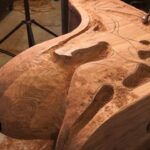
Once the main structure was assembled the most difficult part began: carving the curves.
The outside curves are relatively simple. With carving discs and rasps a smooth shape can be created fairly quickly.
The inside curves are a completely different story. They require many hours of carving and sanding.
This part of the work is physically exhausting. It also requires constant concentration because one small slip of the hand can leave a deep mark on the wood that is almost impossible to fix.
Even though it is tiring it is also one of the most satisfying parts of the entire process because the final shape slowly appears from the solid wood.
Finishing the Mahogany Sofa
After carving and sanding the final step is applying the finish.
Even the inside surfaces must be sealed so the wood does not absorb moisture unevenly. If only one side absorbs moisture the wood can warp over time.
For the finish a hard wax oil was chosen. It protects the wood while keeping the natural texture visible.
Unlike polyurethane varnish it does not create a plastic layer over the surface. It is also much easier to repair later with a light sanding and another coat.
Sofa Specifications
| Feature | Details |
|---|---|
| Wood Type | African Mahogany |
| Total Wood Used | 500+ Kilos |
| Sofa Type | Chaise Lounge |
| Construction | Multiple Joined Boards |
| Joinery | Domino Joints and Dowels |
| Edge Design | Fully Rounded Edges |
| Back Rest Angle | 7 Degrees |
| Finish | Hard Wax Oil |
Advantages of This Solid Wood Sofa
- Extremely strong and durable construction
- Beautiful mahogany grain and color
- Stable structure using multiple boards
- Smooth curved design without sharp corners
- Natural finish that highlights the wood
Possible Drawbacks
- Extremely heavy structure
- Requires many hours of work
- Needs specialized woodworking tools
- Wood movement may still happen over time
Frequently Asked Questions
1. Why was mahogany used for this sofa?
Mahogany was chosen because of its color, grain and stability.
2. How heavy is the sofa?
The construction uses more than five hundred kilos of mahogany.
3. Why not use one single slab?
Multiple boards reduce warping and handle wood movement better.
4. What type of sofa design is this?
It is a chaise lounge design.
5. What angle was used for the back rest?
The back rest was built with a seven degree recline.
6. Why are there no sharp corners?
The design was created so every edge is curved.
7. What finish was applied?
A hard wax oil finish.
8. Why seal the inside surfaces?
To prevent uneven moisture absorption.
9. What joinery methods were used?
Domino joints and dowels.
10. Was this project difficult?
Yes, it turned out to be the most complicated project done so far.
Conclusion
What started as an impossible idea slowly turned into a real project built from solid mahogany. From cutting massive slabs to carving smooth curves, every step required patience and attention.
The final result is a unique piece of furniture made entirely from solid wood and designed to last for many years.
Personal Opinion
In entire process it becomes clear that working with solid wood on this scale is extremely challenging. Handling slabs that weigh hundreds of kilos requires careful planning and the right techniques.
Mahogany appears to be a great choice for a project like this because it is stable, beautiful and easier to work with compared to many other hardwoods. Using multiple boards instead of a single slab also makes sense because it helps control warping over time.
The decision to create a design without sharp corners adds a huge amount of work, but it also makes the final piece look more refined and unique.
Overall the project feels like a mix of design, engineering and craftsmanship. Something that first looked impossible eventually became an amazing result through patience, planning and a lot of effort.

I’m Shubham, a professional carpenter with 11 years of experience in the craft. I specialize in turning high-quality wood into custom furniture, durable cabinetry, and precise structural work. For me, woodworking isn’t just a job—it’s about building things that last a lifetime